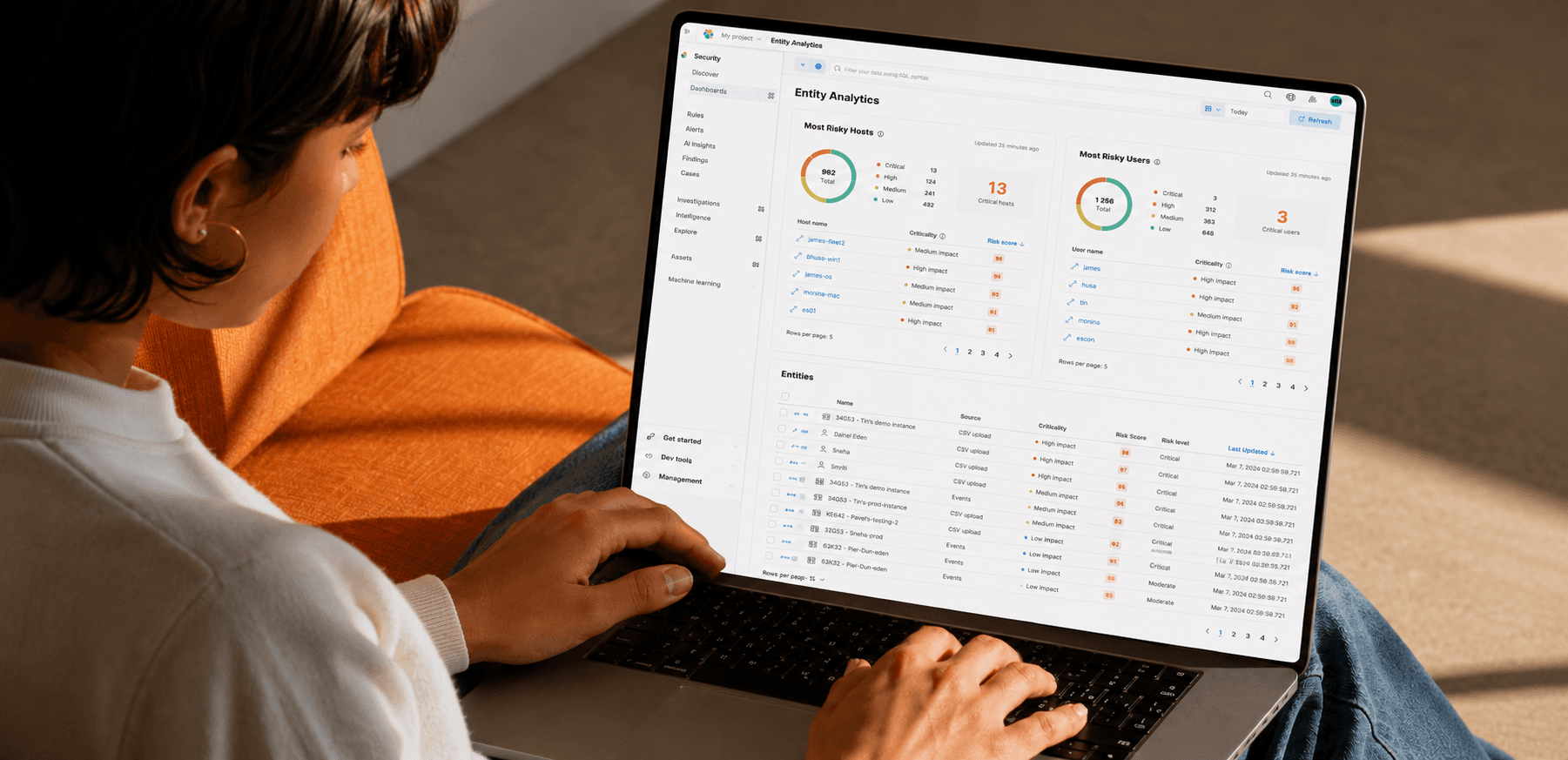
Entity Analytics
Changing where an analyst's day starts, from the alert that fired to the user or host most worth investigating.
Where analysts used to start
Every workflow in the SOC started the same way: an alert fires, an analyst opens it. That works when the alert tells the whole story. It doesn't when the real threat, credential theft, lateral movement, a slow insider, only shows up as a pattern across dozens of alerts over days or weeks.
Entity Analytics moves the starting point. Instead of opening with an alert, analysts open with a risk score for a person or a machine, built from everything already being collected, alerts, asset criticality, watchlists, privileged access, recalculated automatically as the environment changes.
I designed the experience that made that shift work: not just the dashboard that shows the score, but the case for why an analyst should believe it.
Senior Product Designer
I owned this end to end: from the first sketch of a risk-ranked dashboard to the interaction model for how analysts pivot from a score into a full investigation. Data science and ML engineering owned the scoring logic. I owned the harder problem, what to show, when, and why anyone should believe it.
- Set the UX strategy for the feature, from first concept through to what shipped.
- Designed the Entity Risk Dashboard, the breakdown panel, and the pivot into full investigation as one connected workflow, not three separate screens.
- Worked directly with data science and ML engineering to understand what each risk input meant, then decided how much of that complexity analysts actually needed to see.
- Built the configuration model that let analysts adjust their own risk weighting instead of filing a request with data science.
- Made the internal case for reactive-to-proactive as the right frame for this feature, not a UI change, a shift in how analysts were meant to work.
The score was never the hard part
Building a risk score is a data problem. Getting an analyst to act on one, mid-shift, with an incident possibly already unfolding, is a design problem.
The inputs already existed: alerts, asset criticality, watchlists, privileged access. None of that was missing. What was missing was a reason for an analyst to trust a number enough to change what they worked on next.
Entity context lived in a dozen different places. Nobody opens a dozen tabs on purpose before they even know if something is wrong.
A score with no explanation behind it is a black box. Analysts don't act on black boxes, they route around them.
Spotting risk and acting on it were two different systems. Every handoff between them was a chance to lose momentum.
A model tuned for one environment misreads another, and the analysts closest to that gap had no way to close it themselves.
A different way to start the day
An analyst opens Entity Analytics to a ranked list, not a queue: every host and user in the environment sorted by risk, with enough history to tell a spike from a slow climb.
Clicking into an entity doesn't just show a number, it shows why. The breakdown panel traces the score back to what actually drove it, alerts, asset criticality, watchlists, privileged access, weighted and visible, not buried inside a model.
From there, one click pivots straight into Timeline. The analyst never loses the thread between "this looks risky" and "here's the evidence." Score and investigation stay connected, start to finish.
The designed system
Screen designs
Process & flows
The real design problem was trust
The model was data science's problem. Mine was different: deciding what an analyst needed to see, and in what order, before they'd believe a machine's judgment over their own instinct. Those aren't the same problem, and treating them as one is how AI products lose their users.
Every score traces back to its inputs in one click. Not because transparency is a nice value to hold, but because it's the only thing that gets an analyst to act on a number they didn't calculate themselves.
Starting from a risk score instead of an alert isn't a screen redesign. It changes the first question an analyst asks, from "what happened" to "who should I look at", and that's a bigger shift than any single view.
Impact
Every workflow used to start with an alert. Entity Analytics scores two kinds of entities instead, users and hosts, so an analyst can start an investigation from a person or a machine directly, before any single alert ties them together.
Each risk score aggregates four independent signals: correlated alerts, watchlist membership, asset criticality, and privileged access. No single input can inflate a score on its own, which is part of why analysts trust the number enough to act on it.
What used to take a dozen open tabs now takes one pivot. From any risk score, a single click drops an analyst straight into Timeline with the entity's full context already loaded, no manual reconstruction required.
Share of investigation sessions whose first investigative action was an entity risk score rather than an alert, compared before and after the feature reached a cohort.
Entity Analytics changed the question analysts asked first, not "what happened," but "who should I look at." That's a small sentence with a big consequence: it moves the whole workflow from reactive to proactive, and everything below is downstream of that one shift.
A before/after comparison, not a randomised experiment, so other releases in the same window can't be fully separated out. Figures are directional, from internal telemetry, to the best of my recollection following the project.
Learnings & key takeaways
Entity Analytics didn't succeed because the model was good. Data science had already proven the model worked. It succeeded because analysts started trusting what it told them, and that trust had to be designed, deliberately, screen by screen.
The lessons here aren't specific to security. They're about what it takes to ship AI products people actually rely on.
I used to treat explainability as an add-on, a tooltip, a details panel bolted on later. This project changed that. The breakdown panel wasn't decoration on the score, it was the reason the score worked at all.
The underlying risk logic barely changed during this project. What changed analyst behaviour was moving the starting point, from alert to score, and cutting the path from score to investigation down to one click. Same intelligence, different workflow, different outcome.
The instinct with ML features is to expose more, more detail, more confidence, more model internals. Analysts didn't want more information. They wanted less work to trust the information they already had. That's the actual job.