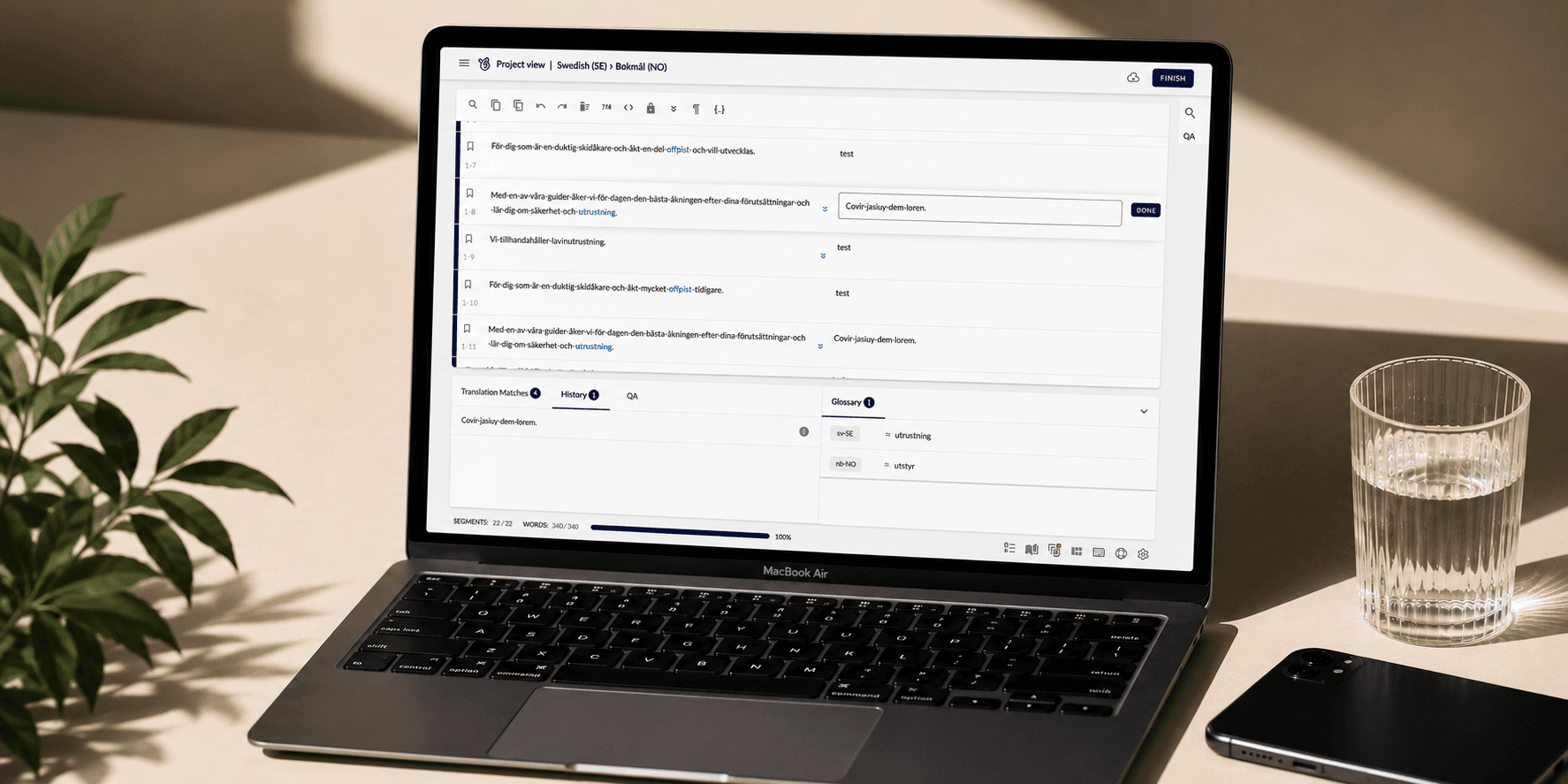
Catch
A CAT tool that puts AI-enhanced translation at the centre of a three-role workflow.
Designing the future of AI-assisted translation
Lengoo's business depended on delivering high-quality enterprise translations powered by a combination of Neural Machine Translation (NMT) and professional linguists. While the AI generated increasingly accurate pre-translations, the company lacked a unified product where translators, reviewers, and project managers could collaborate efficiently. Critical work was spread across disconnected desktop software, email threads, spreadsheets, and customer-specific tools, creating operational friction and limiting the company's ability to continuously improve its machine learning models.
Rather than licensing an existing Computer-Assisted Translation (CAT) platform, leadership made a strategic decision to build one in-house. The goal wasn't simply to replace legacy software. It was to create a proprietary workflow that combined AI and human expertise, protected sensitive enterprise data, and transformed every linguist interaction into feedback that continuously improved the translation models over time.
Lead Product Designer & Design Manager
As Lengoo's first Product Designer reporting directly to the CPO, I defined the product vision and user experience strategy for Catch from concept to launch. As the product evolved, I led a team of four designers, driving the UX strategy across translators, reviewers, and project managers, while aligning Product, Engineering, and Machine Learning teams around shared goals. Beyond delivering the product, I established continuous user research, defined principles for human-AI collaboration, and ensured the platform's long-term alignment with business strategy.
- Defined the long-term UX vision for Catch, shaping the product's direction from concept through launch.
- Led and mentored a team of four designers, ensuring alignment and growth as the product scaled.
- Established the company's first continuous user research program to guide decision-making.
- Aligned Product, Engineering, and Machine Learning around a shared UX strategy, ensuring cross-functional collaboration.
- Defined the product architecture that unified translator, reviewer, and project manager workflows into a single platform.
- Created design principles for trust and transparency in AI-assisted translation, shaping how users interacted with machine intelligence.
Designing trust across three roles and one AI system
Building Catch wasn't about replacing an existing CAT tool. The real challenge was designing a workflow where translators, reviewers, project managers, and AI could collaborate with confidence. Each role depended on different information, worked toward different goals, and interacted with the translation process in different ways. Yet they all relied on the same document and the same AI-generated output. Existing tools fragmented that experience across multiple systems. Context was constantly lost between handoffs, confidence in machine-generated translations was difficult to judge, and valuable human feedback never became part of a continuous learning loop.
Our challenge wasn't to consolidate features into a single interface. It was to design a shared system that made AI trustworthy, collaboration seamless, and every interaction valuable for both people and the model itself.
Translators could not distinguish between high-confidence and low-confidence NMT suggestions, leading to over-editing correct segments and under-correcting risky ones.
The three-role workflow (linguist → reviewer → PM) had no shared visibility. Reviewers could not trace why a linguist made a particular edit; PMs had no live quality signal.
Every client arrived with its own glossaries, forbidden terms, and style guides, and tag formatting had to be preserved by hand. Onboarding new linguists took weeks, the tool's complexity and absence of contextual guidance made the learning curve prohibitively steep for clients scaling fast.
Quality control depended on people: comparing original and translated files side by side in Word, re-checking repeated segments by eye, and anonymizing files manually before a client ever saw them. Nothing caught a punctuation or consistency slip before delivery.
Building a continuous product discovery practice
Designing Catch wasn't about validating a single solution. Machine translation models, customer expectations, and translation workflows evolved continuously, which meant our understanding of the problem had to evolve with them.
As Lengoo's first Product Designer, I introduced a continuous product discovery practice that became part of the team's product development process. Every four months, I planned and facilitated research cycles that combined structured usability studies with open conversations across translators, reviewers, and project managers. Rather than validating isolated features, these cycles helped us understand how people collaborated with AI, where workflows broke down, and how new insights should influence the product roadmap.
This approach shifted research from a one-time activity into an ongoing source of product strategy. It enabled the team to make informed short-term decisions while continuously refining our long-term vision for AI-assisted translation.
Translators didn't want AI to make decisions for them. They wanted enough information to understand when the model could be trusted and when their expertise mattered most.
Every handoff between translators, reviewers, and project managers forced people to reconstruct previous decisions because history, discussions, and terminology lived in separate tools.
Terminology databases and style guides already existed, but users had to interrupt their work to find them. The challenge wasn't missing knowledge. It was delivering it at the right moment.
Users repeatedly performed manual checks that could be automated without removing human judgment. The opportunity was to reduce repetitive work while keeping experts in control.
From insights to product decisions
Rather than solving each problem independently, we designed a cohesive platform where every feature reinforced the same principles: making AI more transparent, preserving context across workflows, and reducing repetitive work without replacing human expertise. Every product decision was intentionally connected to a discovery insight, ensuring the platform evolved as a unified system rather than a collection of features.
The designed system
Process & flows
The product experience
Principles for Designing Trustworthy AI
Designing Catch fundamentally changed how I think about AI products. The hardest challenge wasn't improving the machine translation model itself, it was designing an experience where people understood when to trust AI, when to challenge it, and how their expertise could continuously improve it. Throughout the project, three principles consistently guided every product decision.
One of the earliest insights from research was that translators weren't asking AI to make decisions for them; they wanted enough information to make better decisions themselves. Rather than hiding uncertainty behind simplified labels or treating AI as an invisible assistant, I surfaced confidence scores, historical translation matches, and contextual signals directly within the editing workflow. What I deliberately avoided was stamping a score on every row. Four hundred badges down a document is noise, and people stop seeing it. The signals sit instead in a panel bound to the active segment, so a translator resolves doubt at the moment they feel it, without leaving the editor. By making the model's confidence visible instead of abstracting it away, we helped users calibrate their trust, reducing unnecessary edits while increasing confidence in AI-assisted translation.
Rather than treating human review as a final validation step, I designed it as an integral part of the product. Every edit, correction, and confirmation became valuable feedback that improved both the translation workflow and the machine learning model over time. By embedding this feedback naturally into the editing experience instead of asking users to evaluate AI separately, we created a continuous learning loop where improving the model became a byproduct of everyday work rather than an additional task.
Rather than thinking about AI as a single feature, I approached it as a decision-support system. Each role in the translation workflow made fundamentally different decisions, which meant each required a different level of transparency. Translators needed immediate confidence signals while editing, reviewers needed visibility into how translations evolved over time, and project managers needed meaningful indicators of delivery risk. Designing around these decision points ensured AI complemented human expertise instead of overwhelming it with unnecessary information.
Impact
Post-cycle satisfaction survey one year after launch; share of linguists, reviewers and PMs rating 4–5 on a 5-point scale.
Post-edit distance on high-confidence NMT segments, before vs after confidence indicators shipped.
Share of edit events that produced a usable segment pair for model feedback, from workflow logs.
Clarification requests reaching PMs, per project, before and after segment comments and history shipped.
Catch became Lengoo's primary platform for enterprise translation, fundamentally changing how translators, reviewers, and project managers collaborated with AI. The impact wasn't driven by a single feature, but by a series of product decisions that made AI more transparent, collaboration more connected, and quality assurance part of the everyday workflow.
Measured through the continuous discovery cycle I ran every four months, plus workflow analytics. Sample sizes were small, so figures are directional, to the best of my recollection following the project.
Learnings & key takeaways
Catch became the primary delivery platform for Lengoo's enterprise customers and established the foundation for a more scalable, AI-assisted translation workflow. Beyond the measurable improvements in efficiency and collaboration, the project fundamentally changed how the company captured and learned from human expertise, turning everyday translation work into a continuous feedback loop for improving machine learning.
For me, the project reinforced that designing AI products isn't about maximizing automation. It's about helping people understand, trust, and collaborate with intelligent systems in ways that make both the human and the technology better over time. That principle continues to shape how I approach AI-powered products today.
Before Catch, I thought the success of an AI product depended primarily on the quality of the model. This project taught me that trust is ultimately a design challenge. Giving users visibility into uncertainty, context, and decision history proved far more effective than trying to make AI feel invisible.
The most valuable outcome wasn't replacing human work with automation. It was designing a system where AI handled repetitive tasks while people remained responsible for judgment, creativity, and quality. When AI and human expertise complement each other, both become more effective.
The most valuable outcome of Catch wasn't building a translation platform. It was learning how thoughtful design can transform AI from a tool people use into a partner they trust. That experience fundamentally changed how I approach AI products today. Rather than asking "How can AI automate this?", I now ask "How can design help people understand, trust, and collaborate with AI?" It's a mindset I continue to bring to every AI-powered product I design.